Missing Water? How the Five Elements Shape Chinese Names
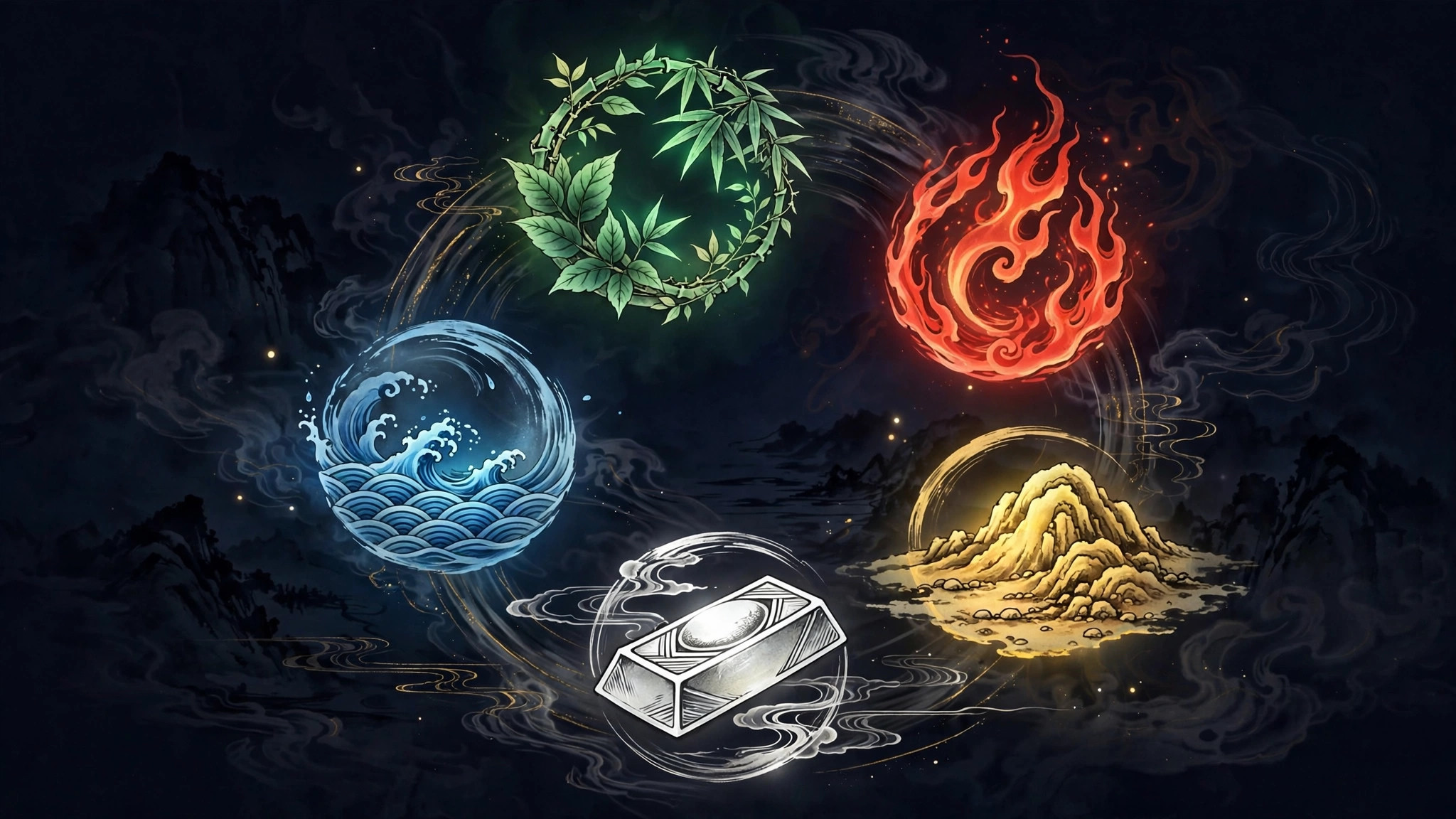
If you've ever heard a Chinese parent say their baby "lacks water" (缺水) or "lacks fire" (缺火), they aren't talking about drinking or heating. They're talking about 五行 (wǔxíng) — the five elements — one of the oldest ideas in Chinese naming tradition.
What Are the Five Elements?
The five elements are wood (木), fire (火), earth (土), metal (金), and water (水). In traditional Chinese thought, everything in the universe — including a person — is a mix of these five forces, constantly generating and restraining each other: wood feeds fire, fire creates earth (ash), earth bears metal, metal enriches water, water nourishes wood.
When a baby is born, traditional naming practice maps the birth date and time onto this system (called 八字, bāzì, the "eight characters"). The result is a personal elemental chart — and almost nobody's chart is perfectly balanced.
What Does "Missing an Element" Mean?
A chart might show strong fire and earth but almost no water. The traditional reading: this child "lacks water." Parents then treat the given name as a way to compensate — choosing characters that carry the missing element's energy to restore balance.
This is the logic behind countless Chinese names. It's not superstition for its own sake; it's a 2,000-year-old system for wishing a child completeness and harmony.
How the Missing Element Gets Into the Name
Chinese characters are ideal for this, because many carry their element visibly in their radicals:
- Lacking water (缺水)? Use the water radical 氵: 涵 (hán, "to contain"), 泽 (zé, "marsh, grace"), 海 (hǎi, "sea").
- Lacking wood (缺木)? Use the wood radical 木: 林 (lín, "forest"), 森 (sēn, "dense forest"), 桐 (tóng, "paulownia").
- Lacking fire (缺火)? Use fire or sun radicals 火/日: 炎 (yán, "flame"), 煜 (yù, "shining"), 晖 (huī, "sunshine").
- Lacking metal (缺金)? Use the metal radical 钅/金: 铭 (míng, "inscription"), 锐 (ruì, "sharp"), 锋 (fēng, "blade's edge").
- Lacking earth (缺土)? Use earth or mountain radicals 土/山: 坤 (kūn, "earth"), 培 (péi, "to cultivate"), 峻 (jùn, "towering").
A summer-born baby, for instance — fire season — often "lacks water," which is why you meet so many Chinese children named with 涵, 泽, or 洋.
One Important Nuance
Real bazi analysis is more subtle than simply "fill in what's missing." Professionals look for the chart's favorable element (喜用神) — the element the person actually needs, which isn't always the absent one. The "add what's missing" approach is the folk version: simple, widely used, and good enough for most families.
Get a Name Matched to Your Birthday
Want a name built around your own elemental chart? Try our Chinese name generator based on birthday — it analyzes your birth date's zodiac and elemental balance and suggests names designed to complete it.
In Chinese naming, a name is a small act of feng shui: a few carefully chosen characters, placed to bring a whole life into balance.